

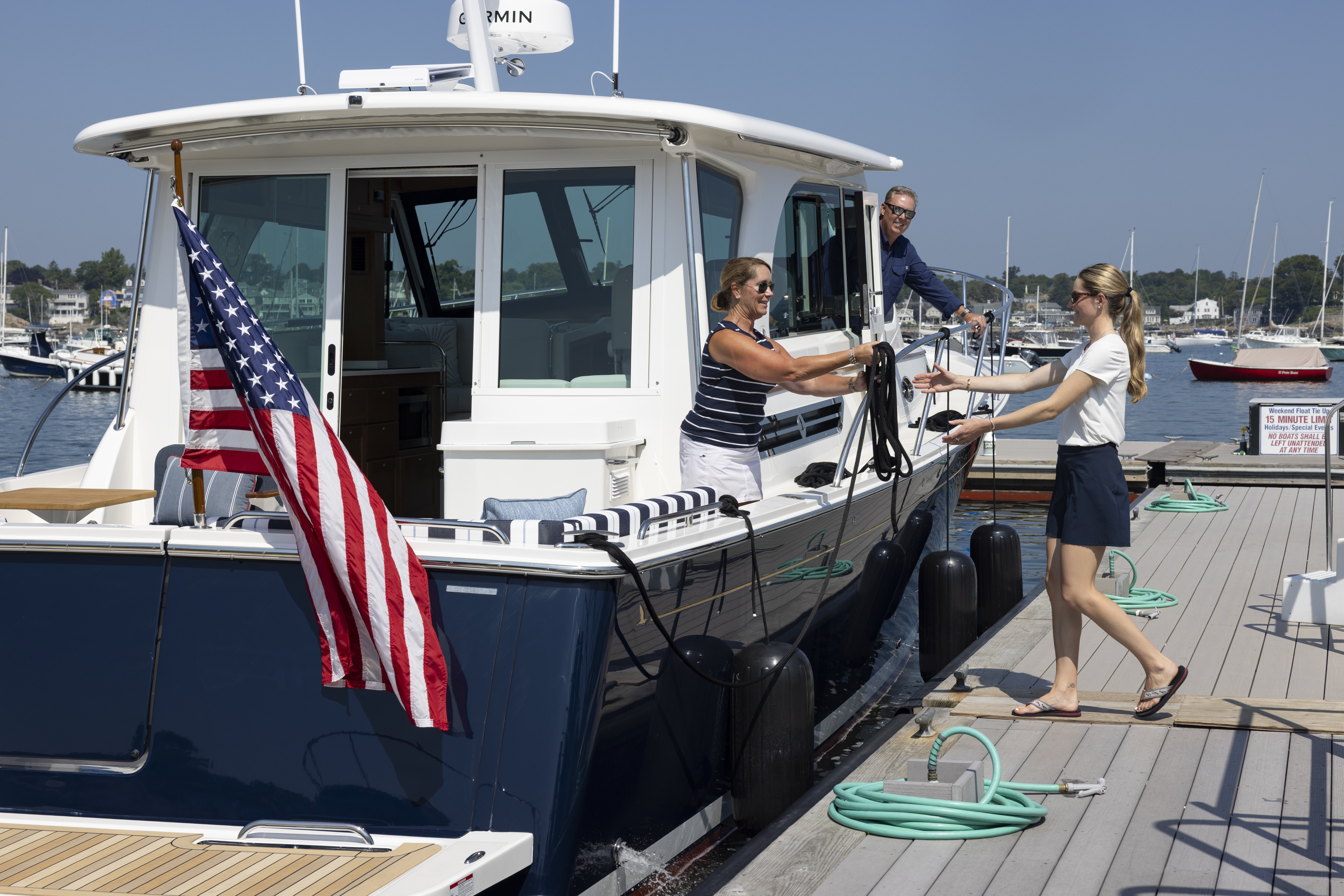
Crew harmony: simple onboard roles that turn tense docking moments into calm teamwork
Docking is where great days can get frayed. Tight fairways, watchful eyes, wind and current—the New England marina mix can test any crew. The good news: a few clear onboard roles and a short, repeatable briefing turn pressure into a practiced routine. Whether you run a Sabre, Back Cove, or Schaefer, the same fundamentals apply—and modern tech like joystick docking and thrusters only works better when your team is aligned.
Start with a 90‑second pre‑docking brief
Call everyone on deck before you turn into the basin. Cover:
- Approach plan: slip number, side to, upwind/up-current strategy, where you’ll stop.
- First line: which line goes on first (usually a midship spring), and to what cleat.
- Crew positions: who is bow, stern, spring, and communicator.
- Safety rules: no hands/feet between hull and dock, step—not jump—ashore, cleat properly.
Keep it simple and end with “Any questions?” so everyone confirms the plan.
Assign simple roles that fit your boat and crew
Define roles before lines come out. On many Sabre and Back Cove models with wide side decks and high rails—and on Schaefer fly bridge models—these assignments are intuitive.
- Helm (Skipper): Drives the plan. Controls speed, thrusters/joystick, and final positioning. One voice from the helm to reduce cross‑talk.
- Spring Line Lead (Midship): Controls the first line to the dock from the midship cleat. This line sets the boat; it’s the most important early move.
- Bow Handler: Manages fenders and the bow line on the dock side, prioritizing the windward bow in crosswinds.
- Stern Handler: Controls the stern line to stop fore‑and‑aft movement and fine‑tune the boat’s final position.
- Communicator/Spotter: Stands amidships with best visibility. Calls distances in feet, watches corners, and liaises with dock staff. If you use headsets (“marriage savers”), this is the person on the other end of the helm.
Short‑handed? Combine roles:
- Two‑person crew: Helm + Midship/Stern combo; bow line laid out for dockhand assistance.
- Family crew of four: Helm, Midship Lead, Bow, Stern; Communicator role taken by Midship Lead.
The midship spring is your calm‑maker
A single line can settle everything:
- Lead a line from your midship cleat to a dock cleat slightly forward of your beam.
- Make fast on the dock (or take a turn on a piling), then the helm holds light forward idle against the spring.
- The boat stops, hugs the dock, and sits quietly while you place bow and stern lines without rush.
This technique is especially effective on single engine Downeast hulls with bow thrusters and on pilothouse trawlers with side doors that make midship access easy. Joystick systems on Schaefer, Sabre and Back Cove outboard, stern drive and IPS models emulate this control, but the first secure line still lowers everyone’s heart rate.
Communication that cuts through noise
Agree on short, unambiguous language:
- Distance: “Ten… eight… six… four… two—stop.” Use feet, not “a little.”
- Commands: “Neutral.” “Ahead dead slow.” “Stern to port.” “Bow thruster to starboard.” “Hold.”
- Status: “Spring made fast.” “Bow on.” “Stern on.” “All secure.”
Hand signals help when engines drown voices:
- Flat palm pushing forward/back = ahead/astern.
- Fingers up = feet remaining.
- Crossed forearms = stop.
One person talks to the helm; others stay quiet unless safety is at stake.
Set your gear before the turn
A 60‑second setup saves minutes on the dock:
- Fenders: Three minimum on the dock side, set for piling height. In New England tides, hang one lower for low water and keep a roving fender in hand.
- Lines: Bow, stern, and midship flaked and led outside rails. Bitter ends on top, no knots. Pre‑tie a long spring if you expect current.
- Tools: Boat hook ready but never used to “stop” the boat. Gloves for handlers.
- Cleat know‑how: Belly wrap, figure‑eights, and a lock turn—no half‑hitches around posts that jam.
Read wind and current like a local
Conditions along Boston Harbor, the North Shore, Cape Cod, and Narragansett Bay shift by tide cycle and marina layout.
- Wind off the dock: Favor a slightly steeper approach. Get the midship spring on first; light forward idle will “pin” you alongside.
- Wind onto the dock: Come in flatter and slower. Let the dock help you; avoid pinching fingers. Make bow and stern fast, then adjust.
- Strong current: Treat current like wind on the underwater part of the boat. Aim your approach into the set, and still secure the midship spring first to stop slide.
Your boat’s propulsion matters. Pod and joystick systems shine in crosswinds; single‑screw trawlers love a spring line and prop walk; bow/stern thrusters on Sabre and Back Cove make lateral nudges easy—but none replace a clear plan.
Sample role play: three crews
- Two aboard (Helmsman 43E): Helm at side door lines up; partner at midship makes spring; helm holds forward idle; partner secures stern then bow; helm eases in neutral.
- Family of four (Back Cove 39O): Helm on joystick; teen at bow with fenders; adult at midship is Communicator and spring lead; teen at stern. Spring first, then bow, then stern.
- Experienced trio (Sabre 45 Salon Express): Helm calls plan; midship makes spring; stern handler stabilizes; bow handler checks pulpit clearance and gets final line.
De‑stress habits that stick
- Slow is professional. Enter the fairway at a walking pace.
- Only step off when the boat is stopped and close—no leaps.
- Keep line tails tidy and hands clear. Never take a full strain around your hand.
- Debrief after you’re tied up: one thing that worked, one to improve. Ten seconds builds mastery.
How Boston Yacht Sales helps you dock with confidence
Every new‑boat delivery from Boston Yacht Sales includes on‑water orientation focused on real‑world docking—line handling, spring‑line techniques, thruster/joystick practice, and crew communication. Our factory‑authorized insight into Sabre, Back Cove, and Helmsman layouts means we tailor roles to your specific side decks, cleat placement, sightlines, and propulsion. For brokerage buyers, we offer the same diligent handover and can arrange docking refreshers at your home marina anywhere along the New England coast.
Ready to turn tense tie‑ups into calm teamwork? Connect with Boston Yacht Sales to schedule a private docking session or to step aboard a Sabre, Back Cove, or Helmsman and see how the right boat—and the right plan—make all the difference.